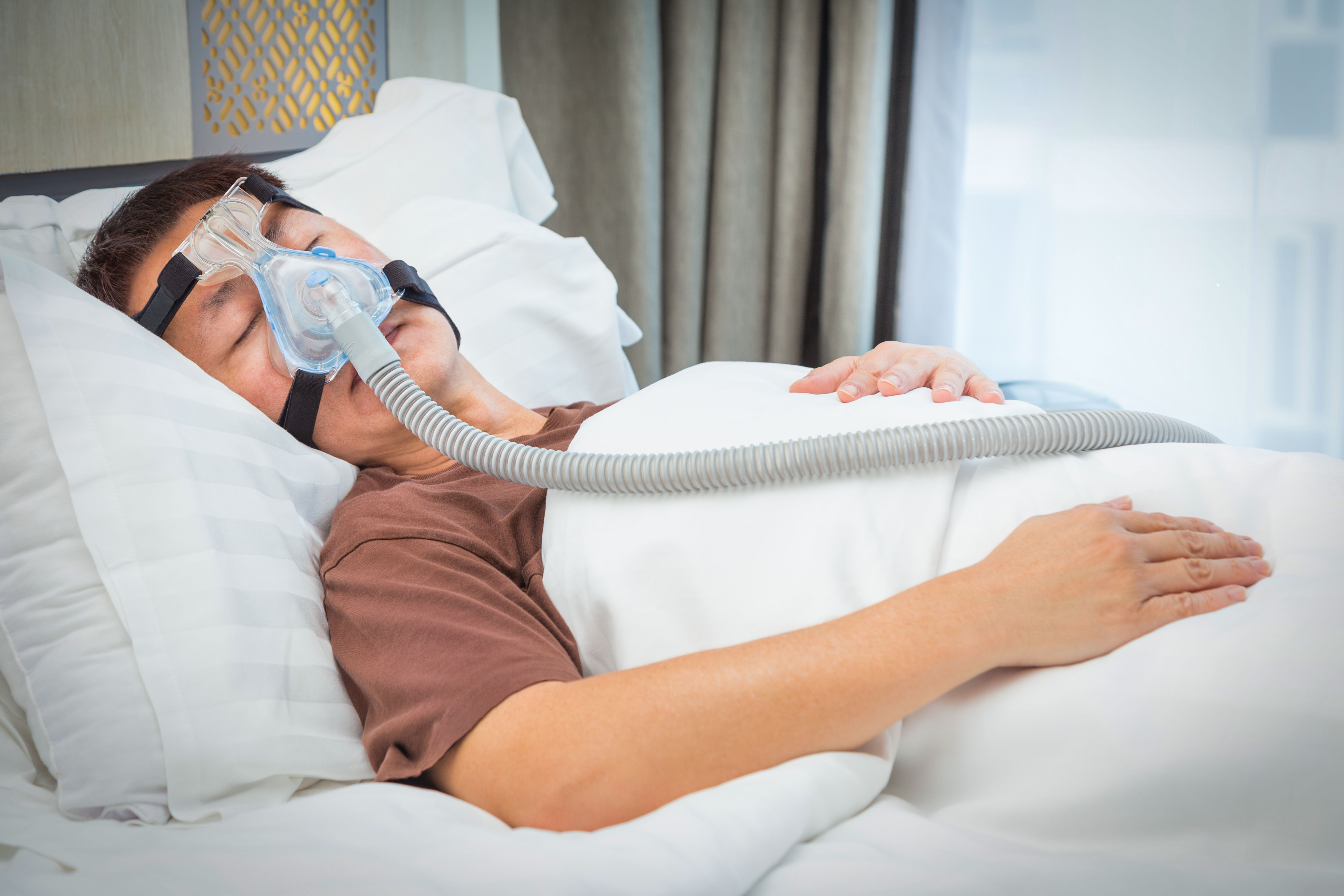
If you snore, wake up tired, or feel sleepy throughout the day, you’re not alone. Millions of people live with undiagnosed sleep apnea or other sleep disorders. For decades, getting answers required in-lab sleep studies and long waiting lists. Today, artificial intelligence (AI) is beginning to reshape that experience. AI doesn’t replace doctors, but can help support them with faster insights, better tools, and more personalized care.
What AI Actually Does in Sleep Care
Artificial intelligence in sleep medicine works mostly behind the scenes. It looks at patterns in large amounts of data, like signals from sleep tests, readings from CPAP machines, information from smartwatches, and even basic health details like age and symptoms. Instead of acting like a robot doctor, AI functions more like an extremely fast assistant that helps highlight trends, estimate risk, and speed up certain parts of the process.
That means AI does not diagnose you on its own. It does not decide your treatment. Instead, it supports clinicians by making pieces of the sleep-evaluation process more efficient and more consistent.
Wearables and Early Risk Detection
One place where people encounter AI without realizing it is in wearable devices like smartwatches and fitness trackers. Many of these devices measure heart rate, movement, and sometimes oxygen levels while you sleep. AI algorithms look at those signals to flag whether someone might be at higher risk for sleep apnea.
For a user, this isn’t a diagnosis, but more like a nudge: “Something about your sleep patterns looks unusual. You may want to talk to a clinician.” These tools help encourage people who might otherwise delay care, but they cannot confirm or rule out sleep apnea. That still requires a proper home sleep apnea test (HSAT) or an overnight laboratory study.
AI and Reading Sleep Studies
If you’ve ever seen photos of a sleep study, you know how complicated the setup can be: sensors measuring brain waves, breathing, oxygen levels, heart rhythms, and more. Traditionally, trained technologists spend hours reviewing these recordings. AI helps by doing an initial “scan” of the night. It sorts sleep into stages, identifies breathing pauses, and highlights any sections of the study that look unusual. Studies show that for many parts of the interpretation, AI performs at a level close to human scorers. But the final decisions are still made by trained clinicians. AI doesn’t diagnose or sign off on a report. It simply speeds up the process and reduces the number of small tasks, so clinicians can spend more time focusing on the results and talking with patients.
Improving CPAP Success with Smart Monitoring
Once someone starts PAP therapy, the first few nights matter enormously. Leaks, discomfort, pressure intolerance, or anxiety about the equipment can make people stop using it. Modern PAP machines can send anonymized data about usage and mask performance to secure platforms. AI can then analyze those patterns to predict who might struggle and who seems to be adjusting well. Instead of waiting for patients to report problems weeks later, clinicians may reach out after just a few nights if the data suggest someone is at risk of giving up. That early support can make a big difference in whether PAP therapy ultimately succeeds.
This isn’t a form of surveillance. It’s a way to catch issues early, when they are easiest to fix.
Finding the Right CPAP Mask Using Technology
Mask comfort is one of the biggest barriers to CPAP success. Recently, AI has been used to help match people with the right mask style and size by analyzing facial photographs or 3D scans. These tools are still new, but early studies suggest they may reduce the trial-and-error period that frustrates many new users. In the future, fully custom-fit masks created with computer-aided design may become more widely available.
Even so, mask fitting remains a hands-on process. AI can offer a starting point, but trained clinicians still help patients test comfort, adjust fit, and choose the mask that works best.
Beyond Sleep Apnea: Insomnia and Body Clock Disorders
AI research is beginning to extend beyond sleep apnea. Scientists are exploring whether patterns in smartphone use, light exposure, or daily activity can reveal insomnia or circadian rhythm problems. These tools are still in early development, but they point toward a future where sleep care is informed by real-world data, not just what happens on the night of a formal test.
What AI Can and Cannot Do
AI brings new possibilities to sleep care, but it still has clear boundaries. It can detect patterns, summarize big sets of data, and flag possible issues. It cannot understand your personal preferences, evaluate how you feel, consider your fears or goals, or replace the experience of a trained clinician. Think of AI as a powerful tool: helpful, efficient, and increasingly accurate. However, it’s still just one part of a larger team whose goal is to improve sleep and health.
If You’re Considering a Sleep Evaluation
You may notice that sleep testing and treatment feel more streamlined than they used to. Results may come faster. You might receive follow-up sooner after starting CPAP. Devices may feel more tailored to your face or needs. If you’re unsure whether AI is being used in your evaluation or treatment, you can always ask your clinician:
- How does AI fit into my sleep care?
- Is a human still reviewing all final decisions?
- How is my data stored and protected?
These are reasonable questions, and good clinicians will welcome them.
The Bottom Line
Artificial intelligence is helping reshape sleep medicine by making testing more efficient, supporting early detection, and offering more personalized help with CPAP therapy. But the core elements, like clinical judgment, shared decision-making, and human connection, remain at the center of good care.
AI may change how we get to a diagnosis or how quickly we solve problems, but the goal stays the same: helping people sleep better, feel better, and live healthier lives.
References
1. Chan, M., Soreca, I., Ali, M. E., Chakravorty, S., Gulla, A., Shroyer, B., & Atwood, C. (2022). 0771 Artificial Intelligence Based Mask Fit Algorithm Application in the Pittsburgh Veteran Population. Sleep, 45(Supplement_1), A335-A336.
2. Sheth, R., Sheth, S., & Audette, M. (2025). Developing Custom‐Fit CPAP Mask Prototype in Patients With Obstructive Sleep Apnea. Journal of Sleep Research, e70146.
3. Abd-Alrazaq, A., Aslam, H., AlSaad, R., Alsahli, M., Ahmed, A., Damseh, R., ... & Sheikh, J. (2024). Detection of sleep apnea using wearable AI: systematic review and meta-analysis. Journal of medical Internet research, 26, e58187.
4. Giorgi, L., Nardelli, D., Moffa, A., Iafrati, F., Di Giovanni, S., Olszewska, E., ... & Casale, M. (2025, January). Advancements in Obstructive Sleep Apnea Diagnosis and Screening Through Artificial Intelligence: A Systematic Review. In Healthcare (Vol. 13, No. 2, p. 181). MDPI.
5. Bandyopadhyay, A., Oks, M., Sun, H., Prasad, B., Rusk, S., Jefferson, F., ... & Seixas, A. (2024). Strengths, weaknesses, opportunities, and threats of using AI-enabled technology in sleep medicine: a commentary. Journal of Clinical Sleep Medicine, 20(7), 1183-1191.
6. Haghighat, S., Joghatayi, M., Issa, J., Azimian, S., Brinz, J., Ashkan, A., ... & Sangalli, L. (2025). Diagnostic accuracy of artificial intelligence for obstructive sleep apnea detection: a systematic review. BMC Medical Informatics and Decision Making, 25(1), 278.
7. Alamoudi, D., Breeze, E., Crawley, E., & Nabney, I. (2023). The feasibility of using smartphone sensors to track insomnia, depression, and anxiety in adults and young adults: narrative review. JMIR mHealth and uHealth, 11, e44123.
8. Langholm, C., Byun, A. J. S., Mullington, J., & Torous, J. (2023). Monitoring sleep using smartphone data in a population of college students. Npj mental health research, 2(1), 3.
9. Kirshenbaum, J. S., Crowley, R. N., Latham, M. D., Pagliaccio, D., Auerbach, R. P., & Allen, N. B. (2025). Comparison of Sleep Features Across Smartphone Sensors, Actigraphy, and Diaries Among Young Adults: Longitudinal Observational Study. JMIR Formative Research, 9(1), e67455.
10. BaHammam, A. S. (2024). Artificial intelligence in sleep medicine: the dawn of a new era. Nature and science of sleep, 445-450.
11. Lopez-Garcia, G., Weissenbacher, D., Stadler, M., O’Connor, K., Xu, D., Gryboski, L., ... & Gonzalez-Hernandez, G. (2025). Automated Insomnia Phenotyping from Electronic Health Records: Leveraging Large Language Models to Decode Clinical Narratives. medRxiv.
12. Scioscia, G., Tondo, P., Foschino Barbaro, M. P., Sabato, R., Gallo, C., Maci, F., & Lacedonia, D. (2022). Machine learning-based prediction of adherence to continuous positive airway pressure (CPAP) in obstructive sleep apnea (OSA). Informatics for Health and Social Care, 47(3), 274-282.
LEGAL DISCLAIMER: Material in this newsletter is provided for general health education and informational purposes and to provide references to other resources only; it may not apply to you as an individual. While Apria Healthcare believes that the information provided through this communication is accurate and reliable, Apria Healthcare cannot and does not make any such guarantee. It is not intended to be a replacement for professional medical advice, evaluation, diagnosis, services or treatment (collectively, “medical treatment”). Please see your healthcare provider for medical treatment related to you and your specific health condition(s). Never disregard medical advice or delay seeking medical care because of something you have read on or accessed through this website. Reading this newsletter should not be construed to mean that you have a healthcare provider/patient relationship.
.png)